
OpenAI Master Class: Mastering OpenAI APIs and Beyond
A three-day, hands-on master class for software engineers who want to build production applications with the OpenAI API and modern LLM tooling. The programme starts with the foundations of the text API, grows into prompt engineering, retrieval and agents, and finishes with multimedia APIs and practical AI-powered developer tools.
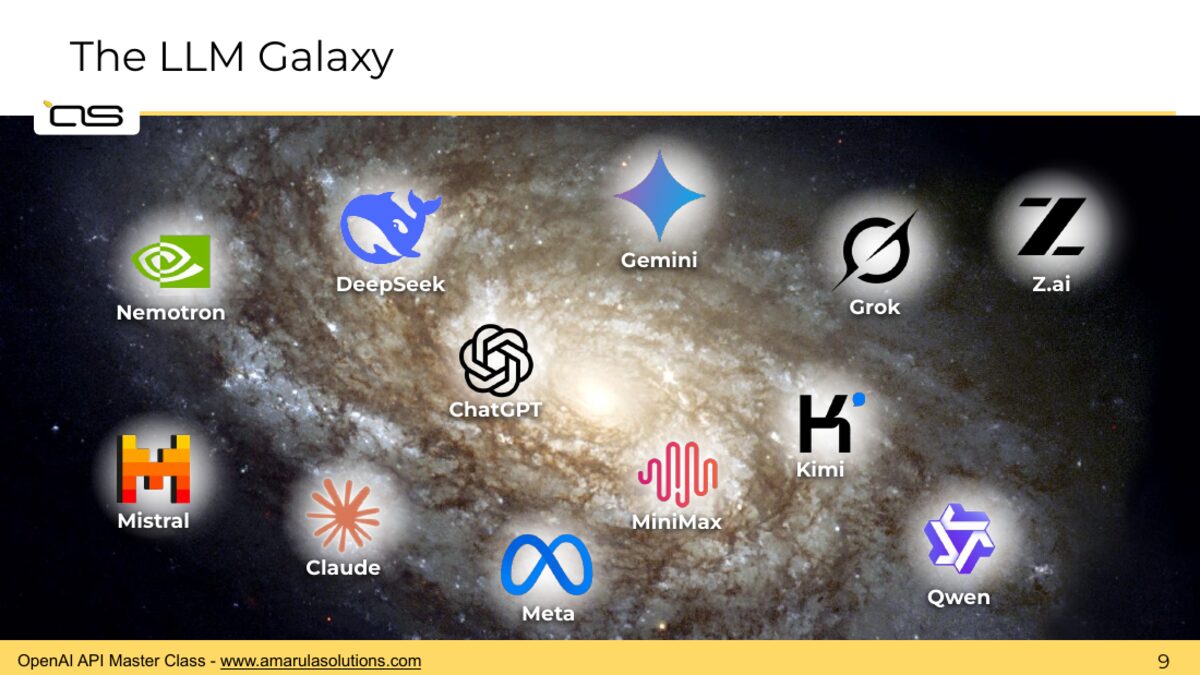
Selected slides from the course deck.
3 days
Minimum 3
€1,350 per participant
Patrizio Gelosi
Download the course preview (PDF)
What you will learn
Integrate OpenAI’s text, vision, audio and image APIs into Python applications.
Choose the right endpoint, model and parameters for quality, latency and cost.
Design prompts and structured outputs that are reliable enough for production.
Build retrieval-augmented and tool-using assistants.
Build single- and multi-agent systems with the OpenAI Agents SDK and provider-agnostic frameworks.
Apply AI to code generation, documentation, debugging and code review.
Who it is for
Software engineers and technical leads building AI features, and developers moving from ChatGPT usage to API integration.
Architects evaluating LLM providers, endpoints and frameworks, and teams adopting AI in their software development workflow.
Prerequisites
Some experience using ChatGPT or another LLM assistant.
Basic Python programming.
Familiarity with REST APIs and JSON.
A laptop with Python 3.10+ and internet access for the hands-on labs.
No machine-learning background is required: the course introduces the concepts from first principles and reinforces them with working code.
Three-day programme
Each day combines short lectures, live API demonstrations and hands-on Python notebooks. The course moves from foundations to agents, then finishes with practical developer applications.
Foundations and the text API
Module 1 — AI: from origins to OpenAI’s breakthrough
Module 2 — Base interaction endpoints
Module 3 — Advanced text API techniques
Prompting and agents
Module 4 — Prompt engineering in API interactions
Module 5 — Agentic AI
Module 6 — Provider-agnostic LLM frameworks
Multimedia and developer applications
Module 7 — Multimedia API
Module 8 — Applications for software development
Module 9 — Applications for code review
Course modules
Module 1 — AI: from origins to OpenAI’s breakthrough
Start with the big picture: how AI arrived at transformers and ChatGPT, where large language models fit in modern software, and how to choose a provider and model with confidence.
The evolution from early AI to transformers, embeddings and ChatGPT
User-centric versus outcome-centric AI adoption, and where to start
How to compare LLM providers on quality, cost, latency and privacy
OpenAI models, SDKs, pricing and token limits
Module 2 — Base interaction endpoints
Learn the three core ways to talk to OpenAI models and when to use each: stateless Chat Completions, lightweight Responses and persistent Conversations.
Chat Completions: messages, roles, parameters and multi-turn history
Responses: instructions, response chaining and temporary requests
Conversations: server-managed state for longer interactions
Model selection: reasoning versus GPT models and endpoint trade-offs
Module 3 — Advanced text API techniques
Move beyond simple prompts. Attach files, call tools, return structured data and ground answers in your own documents with retrieval-augmented generation.
Built-in tools: Code Interpreter, web search, file search and Model Context Protocol (MCP) servers
Function calling and structured JSON outputs
Embeddings, vector search and retrieval strategies
Retrieval-augmented generation (RAG): one-shot retrieval, reranking and hybrid search
Module 4 — Prompt engineering in API interactions
Turn prompting into an engineering discipline: design reusable prompts, control reasoning and improve results through structured iteration.
Prompt components: directives, context, examples and placeholders
Manual and stepwise prompt refinement
Chain of Thought, Tree of Thoughts and meta-prompting
Iterative prompting, response length and variability control
Module 5 — Agentic AI
Build systems that can plan, use tools and act. Start from the ReAct loop, then move to the OpenAI Agents SDK, multi-agent orchestration and persistent agents.
What makes an AI system agentic; ReAct from first principles
OpenAI Agents SDK: agents, runs, sessions and memory
Handoffs, agents-as-tools, guardrails and orchestration
Scheduled, reactive and persistent agent patterns
Module 6 — Provider-agnostic LLM frameworks
Avoid lock-in. Use frameworks that work across providers and learn how to choose between native SDKs, LangChain and DSPy for real applications.
LiteLLM: one interface for hosted and local models
LangChain: prompt templates, agents, middleware and LCEL
LangGraph: stateful, graph-based orchestration
DSPy: modules, signatures and automatic prompt optimisation
Module 7 — Multimedia API
Add speech, vision and image generation to your applications, and understand the quality, latency and cost trade-offs of each modality.
Text-to-speech, transcription, translation and audio understanding
Vision: image inputs, extraction, geolocation and defect analysis
Image generation and editing with DALL·E and GPT Image
Model and pricing trade-offs for multimodal workloads
Module 8 — Applications for software development
Apply LLMs to the software lifecycle: generate and change code, write documentation, debug failures and build AI-powered developer tools.
Code generation, change requests and documentation assistance
Context strategies: whole repository, diffs and on-demand retrieval
Debugging and iterative fixing with reasoning models
Jelliphy: building and editing web applications in the browser
Module 9 — Applications for code review
See how AI can review code at scale, from diff analysis to a production Gerrit plugin, and how to customise review behaviour for your team.
Code review context strategies and review quality
The ChatGPT Gerrit plugin architecture and workflow
Reviewing change sets, votes, comments and commands
Custom prompts, assistant instructions and directives
Your trainer

Patrizio Gelosi is a Senior Software Developer at Amarula Solutions. He holds a Master’s degree in Software Engineering from the University of Pisa and has more than two decades of experience across natural-language processing, document and image processing, web editors and developer tooling.
He designed this master class around the way he builds AI-powered tools at Amarula Solutions: start with a working prototype, understand the model and the API, then iterate until the result is reliable enough for production.
Booking and logistics
Duration: 3 days
Minimum participants: 3
Price: €1,350 per participant
Trainer: Patrizio Gelosi
Format: Instructor-led, hands-on; live API demonstrations and Python notebooks.
Sessions are arranged on request for groups of at least three participants. To reserve a session, request a quotation or contact us.
Course preview
The downloadable preview includes the course overview, the three-day programme and a summary of every module with selected slides from the course deck.