
Jenkins CI/CD: one-day training
Jenkins is the automation server behind many embedded and open-source CI pipelines. This one-day, hands-on training is available in two tracks: one for developers who build and maintain pipelines, and one for administrators who run nodes, shared libraries and credentials.
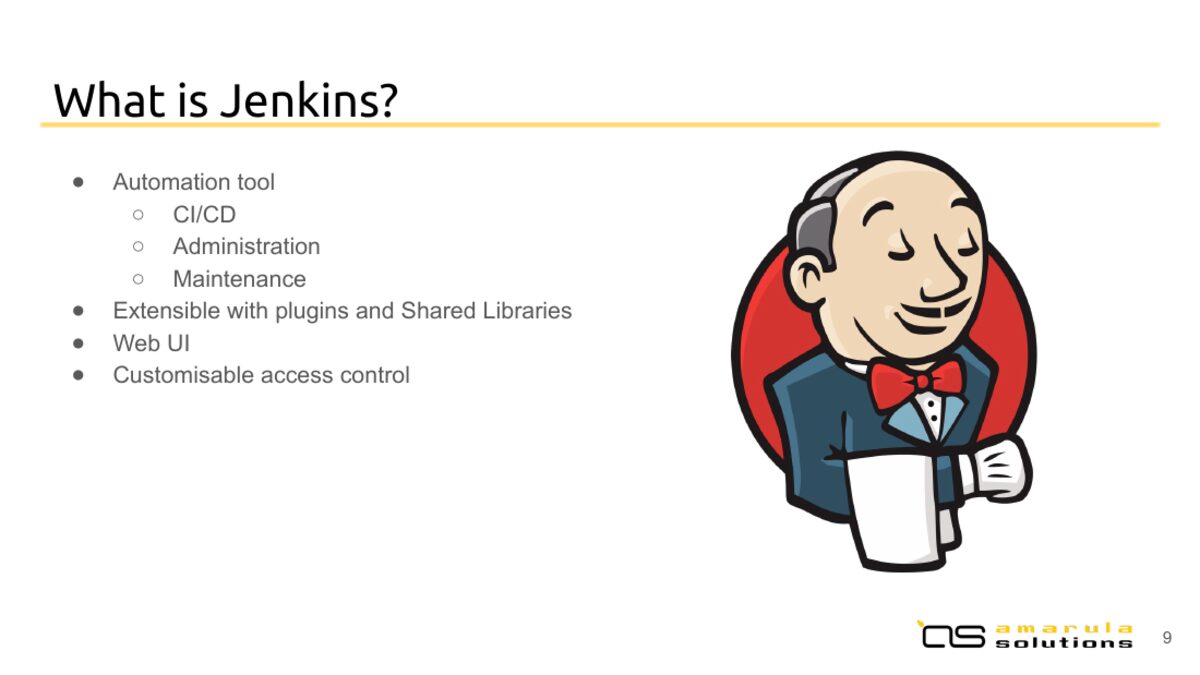
Selected slides from the course deck.
1 day per track
Michael Trimarchi
Users and administrators
On request
Download the course preview (PDF)
Training tracks
Developers and pipeline authors
Duration: 1 day
Minimum: 3 participants
Price: On request
Jenkins administrators, DevOps and CI owners
Duration: 1 day
Minimum: 1 participant
Price: On request
Jenkins for users
A practical day for developers who create jobs, write pipelines and debug builds. The track follows a change from the first commit to a verified build, with hands-on exercises in the Jenkins web UI and in pipeline code.
Minimum participants: 3
What you will learn
Explain continuous integration and delivery, and where Jenkins fits
Work with jobs, pipelines, stages, artifacts, parameters, nodes and Docker
Create folders, pipeline jobs, parameters and build triggers
Write and debug declarative and scripted pipelines
Reuse common code through Jenkins Shared Libraries
Integrate builds with Gerrit Trigger, artifact managers and lockable resources
Agenda
- Morning
CI/CD concepts and the Jenkins role in a review and build workflow
Jenkins terminology: jobs, pipelines, stages, artifacts, parameters, nodes and Docker
Creating pipeline jobs, parameters and Gerrit-triggered builds
- Afternoon
Pipeline scripts and Shared Libraries
Gerrit Trigger, artifact managers and lockable resources
Debugging with console output, replay and Pipeline Syntax
Prerequisites
Basic Git skills: clone, commit and push
Familiarity with continuous integration concepts
Linux command-line basics
A laptop with Git and an SSH client for the hands-on exercises
Jenkins for administrators
A focused day for the people who run Jenkins: nodes, configuration, shared libraries and credentials. Each setting is discussed in terms of its effect on pipeline authors and on the reliability of the build infrastructure.
Minimum participants: 1
What you will learn
Prepare Jenkins nodes: the
jenkinsuser, SSH, Java, Docker and GitUse node labels, offline mode, script console and launch logs
Configure global variables and Global Pipeline Libraries
Manage credentials, scopes and credential IDs used by pipelines
Troubleshoot node connectivity, configuration and pipeline failures
Agenda
- Morning
Jenkins architecture and node requirements
Node maintenance: labels, offline mode, script console and logs
Global configuration: variables and Shared Libraries
- Afternoon
Credentials, scopes and access from pipelines
Operational practices and troubleshooting
Hands-on exercises and Q&A
Prerequisites
Linux command line and SSH basics
Git fundamentals
A basic understanding of CI and code review workflows
Docker basics are helpful
A laptop with Git and an SSH client for the hands-on exercises
Optional testing module
The training can include an optional module on extending Jenkins pipelines to software and hardware testing:
Unit tests, code coverage, memcheck and documentation checks in a pipeline
Jenkins pipeline patterns for automated verification
Labgrid for embedded hardware testing: targets, resources and places
Remote device control, power management and resource locking
A hardware test pipeline that runs on real boards
The module is included when the team wants to extend its Jenkins pipelines beyond building and into automated testing.
Course preview
The downloadable preview includes the course overview, both one-day track outlines and selected slides from the Jenkins course decks.
Your trainer

Michael Trimarchi is co-founder and CEO of Amarula Solutions and a Linux software engineer working on embedded and real-time systems. Michael holds a Master’s degree in Software Engineering from the University of Pisa and is co-author of the first version of the EDF patches submitted to mainline Linux.
Michael teaches this training from the perspective of teams that run Jenkins in production: the pipelines developers use every day, and the administrator decisions that keep the build infrastructure reliable.
Booking and logistics
Jenkins for users: 1 day, minimum 3 participants, price on request.
Jenkins for administrators: 1 day, minimum 1 participant, price on request.
Trainer: Michael Trimarchi.
Format: Instructor-led and hands-on, with live demonstrations and exercises.
Sessions are arranged on request. To reserve a track, request a quotation or contact us.